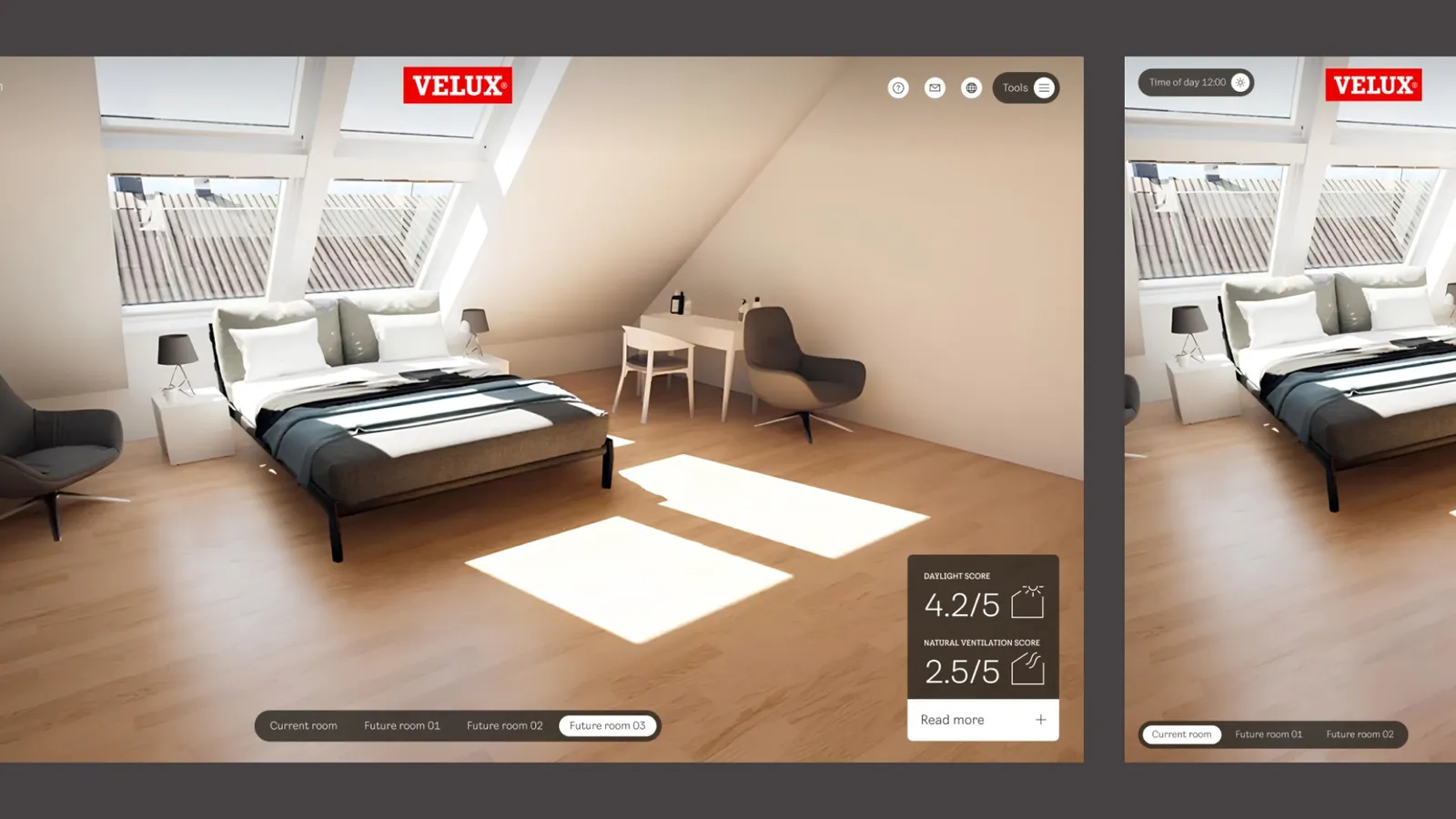
A roof window can turn a dark attic into the best room in the house, but nobody can judge that from a product sheet. VELUX and Merkle built Design Studio, a real-time 3D tool on Unreal Engine 5, so a homeowner can see their own attic with new windows before they commit.
The 3D was the engineering challenge. Mine was everything around it. As Experience Architect, I worked out where Design Studio belongs in VELUX's homeowner journey, and what a single session with a VELUX advisor has to achieve for the customer and for the sale.
Selling something people can't picture
People judge a roof window on things a catalogue can't show: how the light falls at five in the afternoon, how the air moves, what it does to sound in the room. VELUX's advisors had nothing that showed any of it.
There was a timing problem too. VELUX hears the same thing again and again after a renovation: we should have put in one more window. By then the roof is closed and the builders have gone. The cheapest moment to add a window is before work starts, which is exactly when the customer can least imagine the result.
Two users, one screen
Design Studio isn't a self-service configurator. The advisor drives and the homeowner explores, side by side, so every screen had to work for two people with different jobs:
- The advisor needs speed and control: rebuild a room fast, keep the conversation moving, and get to a costed proposal.
- The homeowner needs to touch it: move a window, change the hour, compare options. That's what turns watching a presentation into making a decision.
One session, five stages
I designed the session as a conversation with a beginning and an end, not a demo. Each stage has a job for both people:
One advisor session, end to end
- 01
Rebuild
a virtual copy of the room
- 02
Furnish
add the interior
- 03
Propose
drop in roof windows
- 04
Compare
daylight, ventilation, sound
- 05
Commit
costs, then start a project
What each stage does for both people
| Stage | Homeowner gets | Advisor gets |
|---|---|---|
| Rebuild | “That’s my attic” | Accurate dimensions to propose against |
| Furnish | A room that feels lived in | Context for placement advice |
| Propose | Options rendered in seconds | Several solutions without starting over |
| Compare | Evidence, not adjectives | Scores to anchor the recommendation |
| Commit | A price and a clear next step | A real lead, not a brochure handed over |
Where the session sits in the journey
Saved rooms carry the proposal past the end of the meeting, so the homeowner can come back to it, show it at home, and pick it up again with the advisor.
Ending on a next step, not a picture
A good session shouldn't end with a nice render. The last stage shows the full cost, an estimate of what the windows add to the home's value, and a button that starts a real project. The extra-window decision now happens at the cheapest possible moment: before the builders arrive.
Result
Advisors get one tool that carries a customer from a first look to a costed project in a single meeting. Homeowners see the result before they pay for it.
Images: Merkle / VELUX.